
US and South Korea Reduce Military Exercises as Trump Signals Openness to Kim Talks
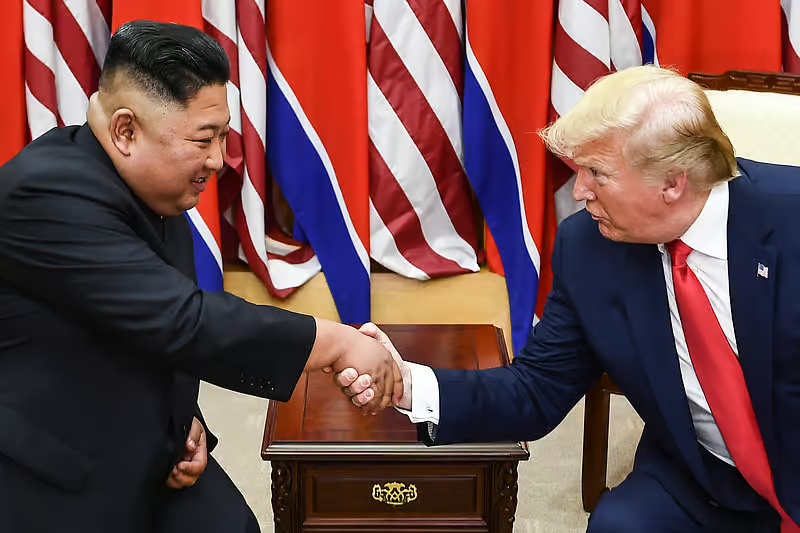
The United States and South Korea have agreed to shorten and reduce the scope of their annual joint military exercises following a directive from US President Donald Trump, who once again highlighted his relationship with North Korean leader Kim Jong Un.
The Ulchi Freedom Shield exercise, which began on August 17, was originally scheduled to continue for 11 days. Under the revised arrangement, the main exercise will conclude on August 21, cutting its duration to five days.
Some live field-training activities will also be cancelled, reduced or converted into computer-based simulations. The second phase of the exercise, involving counterattack operations, has reportedly been removed from this year’s programme.
Trump Highlights Relationship With Kim Jong Un
Trump ordered a substantial reduction in US participation shortly after speaking positively about his past dealings with Kim.
The US president has repeatedly described his personal relationship with the North Korean leader as strong, despite negotiations between Washington and Pyongyang failing to produce a lasting agreement on North Korea’s nuclear programme.
Reports suggest Trump is interested in reviving direct diplomacy with Kim and could seek another meeting during a future visit to Asia. However, neither Washington nor Pyongyang has confirmed plans for a new summit.
Trump previously suspended major US-South Korean military exercises following his first summit with Kim in Singapore in 2018. At the time, he described the drills as costly and provocative.
Seoul Reportedly Surprised by Decision
The sudden decision has raised concerns in South Korea, where officials reportedly received limited advance notice about the extent of the changes.
South Korea and the United States have long maintained that their joint exercises are defensive and necessary to prepare their forces for a potential military crisis on the Korean Peninsula.
Military officials said the revised programme would still meet essential training objectives. However, defence experts warned that reducing joint exercises could affect operational coordination and military readiness.
The exercises are particularly important because US and South Korean commanders regularly rotate between positions and rely on joint training to understand shared procedures and command structures.
North Korea Condemns the Exercises
North Korea criticised the military drills despite the reduction, describing them as a hostile action and accusing Washington and Seoul of increasing tensions.
Pyongyang has historically viewed US-South Korean exercises as preparation for an invasion. Washington and Seoul reject this claim, maintaining that the training is intended to deter aggression and strengthen their combined defence capabilities.
North Korea’s latest criticism, however, did not directly target Trump. Some analysts believe this could indicate that Pyongyang is leaving space open for renewed communication with the US administration.
Kim has continued to advance North Korea’s nuclear and missile capabilities while strengthening military relations with Russia. These developments could make future negotiations considerably more difficult than during Trump and Kim’s earlier meetings.
Debate Over Alliance Readiness
The reduction has renewed debate over whether military exercises should be adjusted to support diplomacy with North Korea.
Supporters believe temporarily scaling back drills could reduce tensions and help create an environment for negotiations. South Korean President Lee Jae Myung has also expressed support for restoring dialogue with Pyongyang.
Critics argue that North Korea has previously used diplomatic negotiations to gain concessions without making permanent changes to its nuclear programme. They warn that reducing exercises without a corresponding commitment from Pyongyang could weaken deterrence.
Ulchi Freedom Shield is one of the two major annual exercises conducted by the US and South Korean militaries. It primarily involves computer-simulated command training, supported by field exercises designed to test the allies’ ability to respond to different security threats.
Uncertain Path Towards Renewed Diplomacy
Trump’s latest decision indicates that renewed engagement with North Korea may once again become a central part of Washington’s approach to the Korean Peninsula.
However, significant obstacles remain. North Korea has shown no indication that it is prepared to abandon its nuclear weapons, while the United States has traditionally demanded progress towards denuclearisation.
Whether the reduced military exercises will lead to renewed talks remains uncertain. For now, the move has delivered a diplomatic signal to Pyongyang while raising fresh questions about military readiness and consultation within the US-South Korea alliance.
The coming months will show whether Trump’s personal diplomacy can reopen negotiations—or whether the scaled-back exercises will remain an isolated concession without a response from Kim Jong Un.