
Tesla Unveils New Roadster With SpaceX-Style Thrusters, Targets 2028 Production
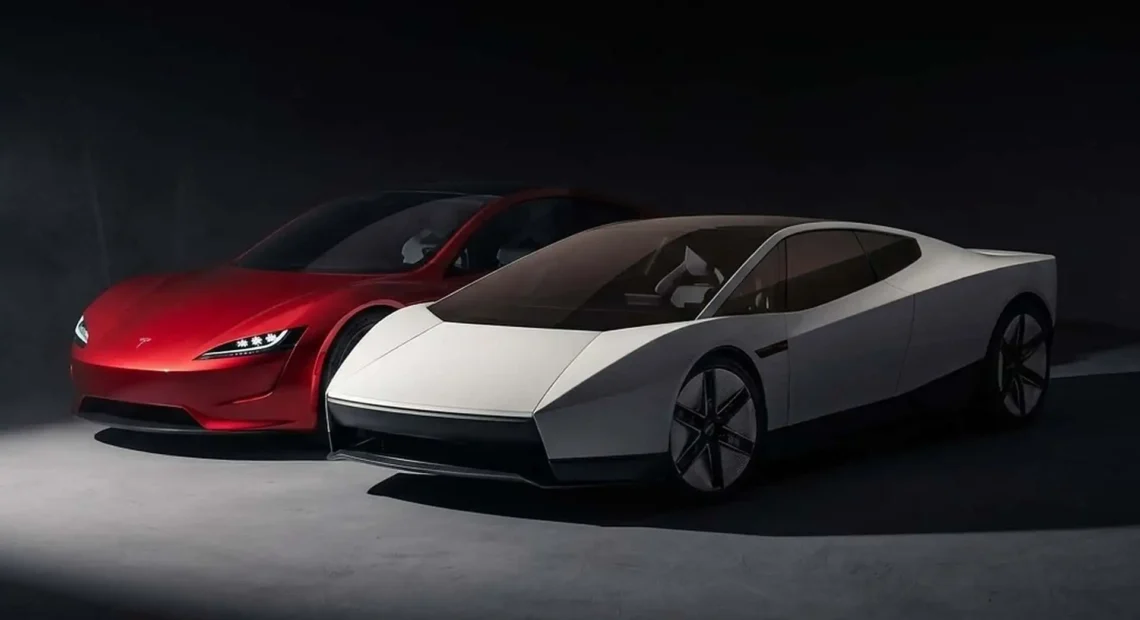
Tesla has unveiled a redesigned version of its long-delayed Roadster, using a dramatic demonstration to position the electric sports car as a flagship showcase for the company’s engineering ambitions. The two-seat vehicle combines conventional battery-electric performance with experimental rocket-style thrusters developed in collaboration with SpaceX.
The event drew attention because the Roadster did more than accelerate on a track. Tesla showed the car driving upside down on a ramp with the help of a suction system, turning in the air and using built-in thrusters during a jump. The display made for an eye-catching launch, but it also underlined a key point: the Roadster remains an upcoming vehicle, not a car that customers will be able to drive home in the near future.
Tesla says production will begin in 2028. That is the latest target for a vehicle that has faced years of delays since a second-generation Roadster was first presented in 2017. At that time, Tesla had expected deliveries to begin in 2020. The new reveal is therefore both a product announcement and a renewed test of the company’s ability to convert ambitious concepts into a production-ready vehicle.
A high-profile unveiling in Texas
Tesla presented the Roadster at a SpaceX test facility in McGregor, Texas, where the company used a launch-style setting of smoke, sound and a countdown to introduce the car. The setting was closely linked to the vehicle’s main talking point: a system of cold-gas, rocket-style thrusters developed with SpaceX.
The new Roadster is intended to be a premium performance model rather than a mass-market EV. Tesla has described the car as a showcase of what its engineers can achieve when vehicle design is combined with aerospace-inspired technology. In the demonstration, the car performed moves that are far beyond the normal expectations of an electric sports car, including a short leap and an aerial manoeuvre.
However, the demonstrations should not be read as proof that Tesla has created a practical flying car. The technology was shown in a controlled environment, and Tesla has not indicated that the Roadster will offer unrestricted airborne use on public roads. Regulations, safety requirements and local vehicle laws would play a major role in deciding how any such features could be used outside a demonstration setting.
Tesla’s performance claims
Tesla says the new Roadster can accelerate from 0 to 60 mph in under one second, reach a top speed above 230 mph, or around 370 km/h, and travel more than 300 miles, roughly 480 km, on a single charge. If achieved in a production model, the acceleration claim would place the Roadster among the quickest cars ever built.
These performance figures should be viewed carefully. They are manufacturer claims made at the launch event and have not yet been independently verified through standard road or track testing. The stated range is also lower than the more than 600-mile target linked to Tesla’s 2017 Roadster concept, showing how the specification has evolved during the project’s long development cycle.
Reservations reopen as Tesla outlines variants
Tesla has reopened Roadster reservations, although it did not announce final pricing during the presentation. The reservation page lists a Performance version requiring a US$50,000 deposit. A Thrust version, which Tesla says includes acceleration thrusters, requires a US$250,000 deposit.
The company also lists a Rocket variant as an invite-only, single-seat version with a “full flight system.” Tesla’s website notes that the Rocket trim will not be available in all regions. The availability, certification and final specification of each version could change before production begins.
Why the Roadster matters to Tesla
The Roadster is not expected to become Tesla’s biggest sales driver. Instead, it gives the company a “halo car” — a model created to show the brand’s technology, attract attention and build excitement around its wider product range. The original Tesla Roadster, which was sold from 2008 to 2012, played a similar symbolic role by demonstrating that an electric vehicle could be fast, desirable and exciting to drive.
Today, Tesla operates in a much more competitive EV market. Its core models compete with an expanding list of electric cars from global manufacturers, while the company is also spending heavily on autonomous-driving systems, robotaxi services and robotics. A striking new Roadster gives Tesla a high-visibility product at a time when it is trying to present itself as more than a conventional carmaker.
The SpaceX link also gives the vehicle a strong identity. Both companies are led by Elon Musk, and their shared involvement in the Roadster allows Tesla to present the car as a meeting point between automotive engineering and aerospace experimentation. Whether that technology translates into a usable customer feature will depend on further development and regulation.
From spectacle to production
The distance between an impressive prototype demonstration and a customer-delivered vehicle can be considerable. Tesla will need to finalise the Roadster’s engineering, confirm safety and regulatory compliance, build a production process and set clear delivery expectations. It will also need to show which features are standard, optional or limited to specialist versions.
There are practical questions around the car’s thruster technology. Any feature that changes the vehicle’s movement beyond normal driving will attract close attention from regulators and insurers. Consumers will also want to know how the system affects maintenance, servicing, driving modes and real-world usability. Tesla has not yet provided detailed public answers to those questions.
The Roadster’s actual commercial impact is likely to be limited compared with Tesla’s larger vehicle programmes. But its brand impact could be significant. A successful launch would give Tesla a headline product with extraordinary claimed performance; another delay or a reduction in promised features would renew scrutiny of the company’s long timelines.
For now, the redesigned Roadster offers a bold preview of Tesla’s next performance car. The launch has delivered spectacle, fresh claims and a new production target. The more difficult part begins now: proving that the technology can be manufactured, certified and delivered to customers when Tesla says it will.