

Meta and Anthropic Sell Two Very Different Visions of AI’s Future
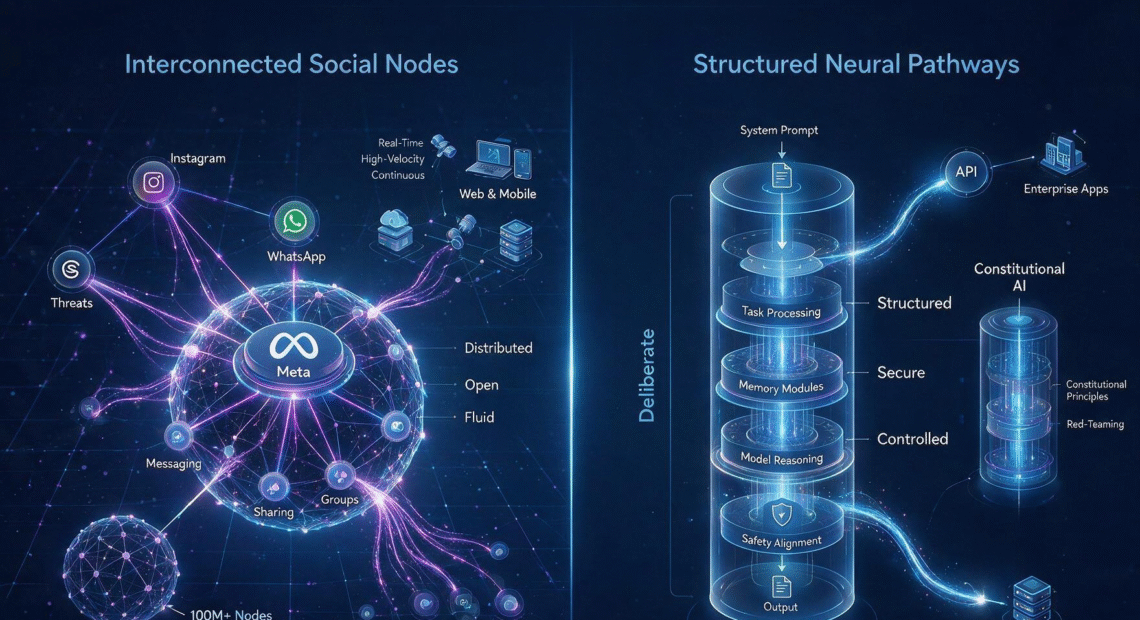
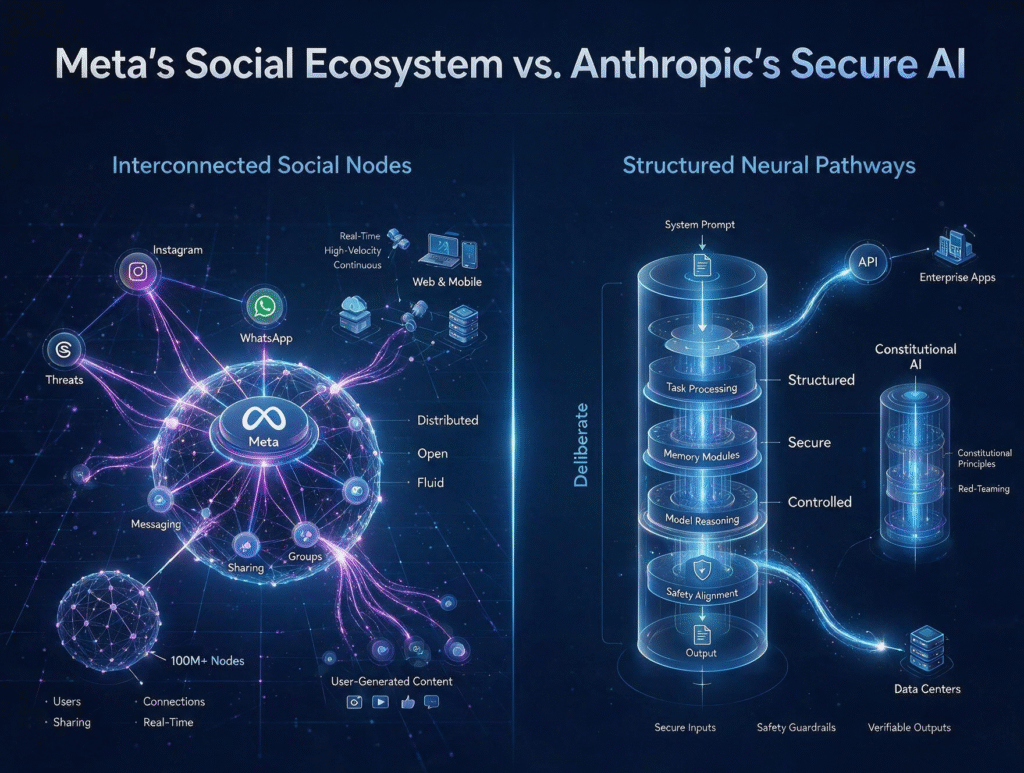
Two of the world’s leading artificial intelligence companies are addressing public anxiety about AI, but their latest advertising campaigns could not look more different.
Meta and Anthropic have released major promotional videos presenting contrasting interpretations of artificial intelligence and its future role in society.
While Anthropic’s campaign asks viewers to confront serious questions about AI safety and accountability, Meta presents a colourful and optimistic vision in which technology helps people connect, create and move forward.
The campaigns arrive as technology companies compete not only to build more powerful AI systems, but also to influence how the public feels about them.
Anthropic Focuses on the Risks
Anthropic’s campaign adopts a deliberately unsettling tone.
The video opens with disturbing scenes, including a burning house, surveillance technology, homelessness, and a cemetery. Human voices raise questions about whether AI can be trusted, who should control the technology, and what should happen when its development begins to move in a dangerous direction.
The campaign eventually becomes more hopeful, suggesting that AI could help people become better teachers, parents, and problem-solvers. However, its closing message—centred on finding hope amid difficult questions—reminds viewers that the risks surrounding AI cannot simply be ignored.
Claude, Anthropic’s AI assistant, receives relatively limited product exposure. Its branding appears subtly toward the end of the campaign rather than being placed at the centre of the story.
The approach appears designed to position Anthropic as a company willing to acknowledge uncertainty and discuss the possible consequences of advanced AI development.
Meta Chooses Optimism
Meta’s campaign takes almost the opposite approach.
It begins by briefly acknowledging headlines about job losses, social isolation and the possibility of people being left behind by AI. The visual style then shifts from black and white to bright colour, replacing anxiety with images of families, friendships, children, celebrations and everyday human connections.
The message is straightforward: Meta believes AI can expand opportunities instead of reducing them.
The campaign concludes with the statement “The future is for everyone,” presenting Meta as an optimistic technology company that wants AI tools to be widely accessible.
Unlike Anthropic’s subtle branding, Meta prominently features its products and platforms. Facebook, Instagram and WhatsApp appear throughout the advertisement, along with a reference to the company’s Muse Spark 1.1 AI model.
Meta CEO Mark Zuckerberg has also said the company wants to give people tools that help them reach their potential while ensuring the benefits of technology are distributed more broadly.
Similar Concerns, Different Stories
Both advertisements begin from the same basic reality: many people remain uncertain about artificial intelligence.
Employees are concerned about automation and job security. Parents are questioning how AI may affect children and education. Governments are debating safety, privacy, and regulation. Consumers are also trying to understand which AI companies they can trust.
Anthropic responds to these concerns by placing them directly in front of the audience. Its campaign suggests that responsible AI development begins by asking uncomfortable questions.
Meta responds by quickly moving beyond the fears. Its advertisement argues that pessimistic predictions should not prevent society from recognising AI’s potential benefits.
The difference can be summarised clearly: Anthropic wants viewers to think carefully about what could go wrong, while Meta wants them to imagine what could go right.
Although Meta’s advertisement does not directly mention Anthropic, the similar structure and close release timing have encouraged comparisons. Business Insider reported that Meta had started developing its campaign before Anthropic released its video, meaning it should not necessarily be viewed as a direct response.
Meta’s Soundtrack Creates an Unexpected Contrast
Meta’s advertisement also attracted attention for using David Bowie’s song “Five Years.”
Without its broader context, the selected portion sounds emotional and uplifting. However, the full song describes people learning that Earth has only five years remaining before destruction.
The contrast between the song’s apocalyptic meaning and Meta’s optimistic AI message created an unexpected layer of irony around the campaign.
Anthropic’s darker visual language may actually be closer to the original mood of Bowie’s song, despite Meta using it for a campaign focused on hope and human potential.
Winning Public Trust Will Require More Than Advertising
The competing campaigns show that the AI industry has entered a new phase.
Companies are no longer promoting AI only through technical demonstrations, model scores and product announcements. They are now creating emotional narratives intended to shape public opinion.
That challenge may be difficult to solve through advertising alone.
A Pew Research Center survey published in June 2026 found that 40% of American adults expected AI to hurt society over the following 20 years. Far fewer expected its overall impact to be positive. Younger adults were particularly sceptical about the technology’s future consequences.
These findings suggest that attractive videos and memorable slogans may not be enough to overcome concerns about employment, misinformation, privacy, surveillance and corporate control.
Public confidence will ultimately depend on how AI systems perform in the real world, how safely they are developed and whether their benefits are shared beyond a small number of technology companies.
Read: GITEX AI Asia 2026 to Bring Global Tech Leaders to Singapore
Two Visions of the Same AI Future
Meta and Anthropic may be developing similar underlying technologies, but their advertisements reveal very different communication strategies.
Anthropic presents AI as a powerful development that must be approached with caution, transparency, and difficult conversations.
Meta presents it as a hopeful tool capable of strengthening creativity, opportunity and human connection.
Neither campaign completely resolves the questions surrounding artificial intelligence. Together, however, they demonstrate how strongly the industry wants to influence the story society tells about AI.
The next stage of competition between major AI companies may therefore be fought on two fronts: building the most capable technology and convincing the public that their particular vision of the future deserves to be trusted.